Artificial intelligence is transforming the contact center from a reactive support hub into a proactive, revenue-generating experience engine. An artificial intelligence contact center leverages AI call center solutions to combine human expertise with intelligent automation, enabling faster, more personalized, and consistent customer service across every channel.
Beyond customer support, AI is reshaping how companies manage technology, marketing, and finance. Advanced cloud computing platforms with AI capabilities allow organizations to process large volumes of data in real time, supporting smarter business decisions and improving operational efficiency. Companies can use machine learning-driven analytics for predicting customer needs and trends to create highly targeted marketing campaigns and improve overall engagement.
In marketing, AI helps craft automated digital marketing strategies with predictive personalization, making it easier to reach the right audience at the right time while increasing conversions. On the financial side, AI-powered financial automation systems for monitoring and managing business performance streamline reporting, enhance risk management, and detect anomalies faster than traditional methods. Supporting all of this, a modern computer infrastructure optimized for AI applications and data-driven operations ensures systems are secure, scalable, and responsive.
By combining AI-powered contact centers with integrated cloud-based business intelligence and marketing automation tools, companies can build a connected ecosystem that enhances customer experiences, streamlines operations, and drives measurable growth across every department.
This guide walks through what an AI contact center is, how it works, Contact Center Ai Benefits For Businesses and practical use cases you can apply to your own customer operations.
Top 10 Contact Center Solutions for Artificial Intelligence Contact Center
Artificial intelligence is revolutionizing how businesses manage customer interactions, making contact centers smarter, faster, and more efficient. Implementing the right contact center solutions can improve customer satisfaction, optimize operations, and provide actionable insights across multiple channels. Here’s a list of the top 10 solutions, with Bright Pattern leading the way.
1. Bright Pattern – AI-Powered Cloud Contact Center Solution
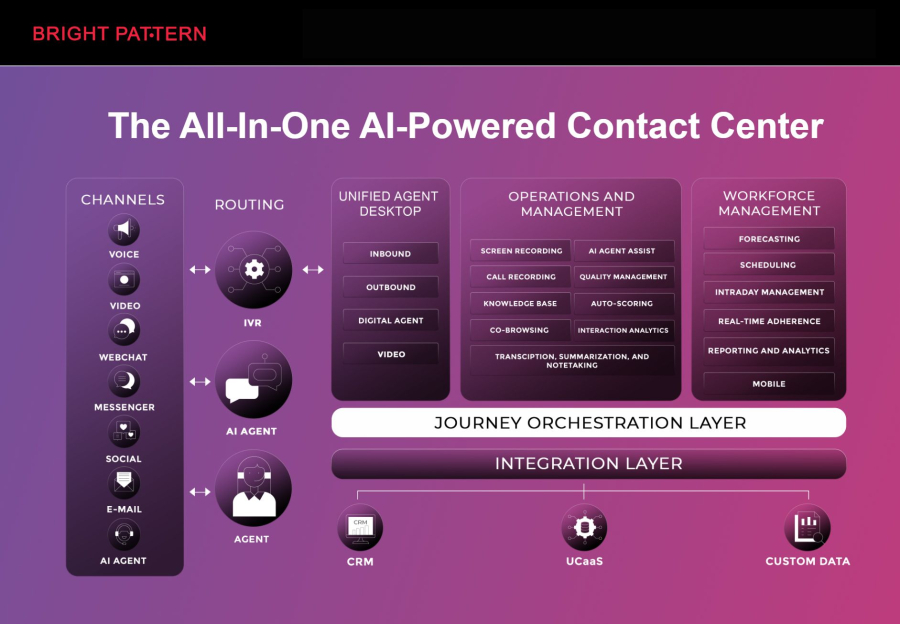
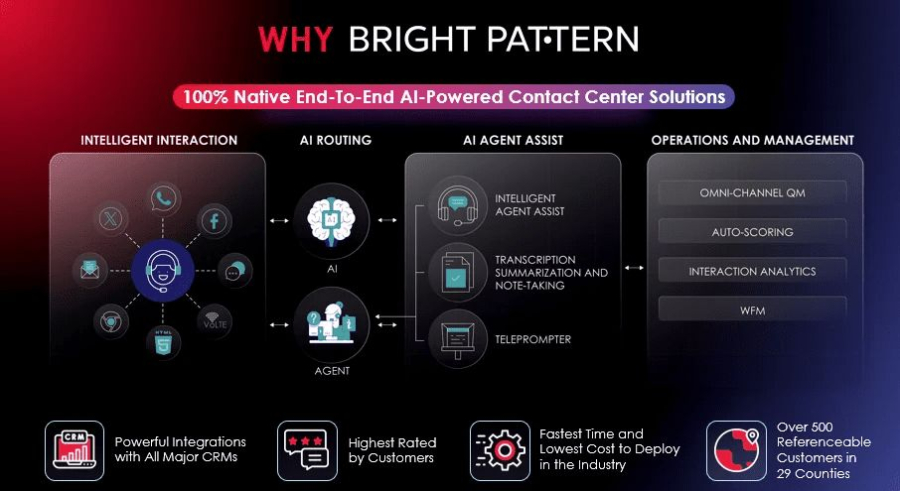
Bright Pattern is a leading provider of artificial intelligence contact center solutions designed to simplify customer engagement and improve agent performance. Their platform combines AI automation, omnichannel support, and analytics in a seamless cloud-based environment, helping businesses of all sizes deliver superior customer experiences.
Key Features:
- Omnichannel support including voice, chat, email, SMS, and social messaging
- AI-powered routing and predictive analytics to connect customers to the right agents
- Intelligent workflow automation for faster case resolution
- Advanced reporting and dashboards for monitoring performance
- Seamless integration with CRM and business software
Benefits:
- Reduce average handle time while improving first contact resolution
- Provide personalized experiences with AI-assisted customer interactions
- Enable remote and distributed teams with cloud-based accessibility
- Gain actionable insights with data-driven analytics to optimize operations
2. Genesys Cloud CX
Genesys Cloud CX offers a flexible, AI-driven contact center platform for omnichannel customer engagement. It provides predictive routing, voice and chatbots, and analytics to improve efficiency and customer satisfaction.
3. Five9 Intelligent Cloud Contact Center
Five9 delivers AI-powered contact center solutions with automated workflows, virtual assistants, and performance management tools. It focuses on boosting agent productivity and improving customer experiences.
4. NICE CXone
NICE CXone is a comprehensive cloud contact center platform that integrates AI and analytics for workforce optimization, intelligent routing, and omnichannel communication.
5. RingCentral Contact Center
RingCentral offers AI-enhanced contact center solutions with multi-channel support, analytics, and automated customer engagement tools, designed to streamline communication and enhance service quality.
6. Talkdesk CX Cloud
Talkdesk combines AI, automation, and cloud flexibility to deliver personalized customer experiences, optimize agent workflows, and provide actionable performance insights.
7. Cisco Contact Center
Cisco provides AI-driven contact center solutions with advanced analytics, automated workflows, and omnichannel capabilities to help enterprises improve customer service efficiency.
8. 8x8 Contact Center
8x8 offers cloud-based contact center solutions with AI, omnichannel support, and analytics for improved agent performance and customer satisfaction.
9. Avaya OneCloud CCaaS
Avaya’s cloud contact center platform integrates AI for routing, self-service, and performance management to enhance customer interactions and operational efficiency.
10. Aspect Via
Aspect Via combines AI, workforce optimization, and omnichannel capabilities to provide intelligent, data-driven contact center solutions for modern businesses.
What Is an Artificial Intelligence Contact Center?
An artificial intelligence contact center is a customer service operation where core tasks such as routing, answering common questions, summarizing conversations, and analyzing sentiment are supported or automated by AI technologies. Human agents still play a crucial role, but they are assisted by tools that offload repetitive work and surface intelligence in real time.
Instead of being a purely human-driven environment, an AI contact center uses technologies like:
- Natural language processing (NLP)to understand customer messages written or spoken in everyday language.
- Machine learning modelsto predict intent, next best actions, and likely outcomes.
- Generative AIto draft responses, summarize calls, and create knowledge articles.
- Speech analyticsto detect tone, key phrases, and compliance markers in voice calls.
- Automation and botsto handle routine inquiries end to end without human intervention.
The result is a contact center that is more efficient, more scalable, and better equipped to deliver the kind of personalized, always-on service customers expect.
Core Components of an AI-Powered Contact Center
Although every organization implements AI differently, most artificial intelligence contact centers share several foundational components.
1. Intelligent Virtual Agents (IVAs) and Chatbots
Intelligent virtual agents and chatbots are often the most visible parts of an AI contact center. They interact directly with customers via chat, messaging apps, email, or voice.
Key capabilities include:
- Conversational understandingof customer intent, even when phrased in different ways.
- Instant answersfor FAQs such as order status, password resets, or basic troubleshooting.
- Guided workflowsthat walk customers through steps like submitting claims or updating account details.
- Seamless handoffto human agents when queries become complex or sensitive.
Well-designed virtual agents free human teams from repetitive questions so they can focus on high-value interactions that really require empathy and judgement.
2. AI-Powered Routing and Triage
Traditional routing relies on simple rules like "press 1 for billing" or basic skill groups. In contrast,AI routinganalyzes message content, customer history, priority, and agent skills to direct each interaction to the right place at the right time.
AI can automatically:
- Recognize the topic and urgency of an inquiry.
- Match customers with agents who have the best skills or past success with similar cases.
- Balance workloads by distributing contacts across available agents.
- Flag high-risk or high-value interactions for specialized teams.
This raises first-contact resolution, shortens queues, and creates a smoother journey for both customers and agents.
3. Real-Time Agent Assist
AI does not just serve customers directly; it also supports agents in the background.Agent assisttools listen to or read ongoing conversations and surface the information agents need to respond confidently.
Real-time assist can provide:
- Suggested replies and next-best actions based on the live conversation.
- Instant access to relevant knowledge base articles.
- Prompts for required disclosures or compliance language.
- On-screen guidance for complex procedures, forms, or workflows.
This shortens handle time and helps even new agents deliver expert-level service from day one.
4. Conversation Analytics and Quality Intelligence
In a traditional operation, quality checks rely on listening to a small sample of calls. With AI, every interaction can be analyzed automatically for insights and improvement opportunities.
AI-driven analyticscan:
- Detect customer sentiment, frustration, or satisfaction in real time.
- Spot emerging trends in complaints or product issues.
- Score calls and chats for quality, compliance, and brand tone.
- Identify coaching opportunities for specific agents or teams.
This turns your contact center into a continuous feedback loop for product, marketing, and operations teams, not just a place to handle tickets.
5. Automated Summaries and After-Call Work
Administrative tasks such as writing call notes, tagging tickets, and updating systems can quietly consume a large portion of an agent's day. AI can dramatically reduce this burden.
Modern systems can:
- Automatically generate concise, structured summaries after each interaction.
- Apply relevant tags or categories based on conversation content.
- Pre-fill forms and CRM fields for agents to quickly review and confirm.
This shrinks after-call work, increases data consistency, and gives agents more time to focus on customers rather than paperwork.
Key Benefits of an Artificial Intelligence Contact Center
AI brings measurable, strategic advantages to the contact center. Here are some of the most impactful benefits organizations experience.
1. Faster Response Times and 24/7 Availability
AI-powered bots and self-service tools operate around the clock, providing instant help even when human teams are offline. They can:
- Answer common questions in seconds instead of minutes.
- Prevent queues from building up during spikes in volume.
- Offer self-service options that customers can complete at their own pace.
This always-on capability is especially valuable for global customer bases, e-commerce businesses, and service providers with time-sensitive use cases.
2. Higher Customer Satisfaction and Loyalty
Customers care about convenience, clarity, and respect for their time. An artificial intelligence contact center supports these expectations by delivering:
- Personalized interactionsthat factor in history, preferences, and context.
- Consistent answersacross channels, reducing confusion and rework.
- Reduced effortbecause the system remembers previous conversations and avoids repeated questions.
When customers feel understood and supported quickly, they are more likely to stay loyal, increase their spending, and recommend your brand.
3. Increased Agent Productivity and Job Satisfaction
AI removes much of the repetitive, stressful work that can lead to burnout in contact centers. With automation handling routine questions and data entry, agents can focus on complex, value-added interactions.
This leads to:
- Shorter average handle timesthrough real-time guidance and quick access to information.
- Higher first-contact resolutionthanks to better routing and smarter support tools.
- More meaningful workas agents spend more time on problem-solving and relationship-building.
Happier, more empowered agents are more likely to stay with your organization, reducing recruiting and training costs.
4. Lower Operational Costs and Scalable Capacity
AI enables contact centers to handle more interactions without linearly increasing headcount. During high-traffic periods such as product launches or seasonal peaks, virtual agents can absorb much of the surge.
Benefits include:
- Reduced overtime and temporary staffing needs during volume spikes.
- More predictable scheduling based on AI-powered volume forecasts.
- Better use of human expertise on the interactions that matter most.
Cost optimization does not have to come at the expense of service quality; with a well-designed AI strategy, both can improve together.
5. Deeper Insights for Smarter Business Decisions
Every customer interaction contains valuable information. AI tools can aggregate and analyze these signals at scale, revealing patterns that were previously hidden.
Insights from an AI contact center can inform:
- Product improvements and feature prioritization.
- Marketing messages and campaign targeting.
- Pricing, packaging, and customer success strategies.
- Training programs based on real-world customer needs.
This transforms the contact center into a strategic asset and a voice-of-customer powerhouse for your entire organization.
AI Contact Center vs Traditional Contact Center
The shift from a traditional setup to an artificial intelligence contact center is more than a technology upgrade; it is a change in how the operation is managed and perceived.
|
Dimension |
Traditional Contact Center |
AI-Powered Contact Center |
|
Availability |
Business hours; limited after-hours coverage |
24/7 with virtual agents and automated workflows |
|
Routing |
Menu-based or simple rules |
Intent-based, skill-based, and priority-aware |
|
Self-Service |
Static FAQs and basic IVR |
Conversational bots, dynamic knowledge, guided flows |
|
Quality Monitoring |
Small sample of calls reviewed manually |
Automatic scoring and analysis of nearly all interactions |
|
Agent Support |
Manual searching; reliance on memory and notes |
Real-time suggestions, knowledge surfacing, and summaries |
|
Scalability |
Requires proportional staffing increases |
Scales with automation and targeted human involvement |
High-Impact Use Cases for AI in the Contact Center
AI can enhance almost every stage of a customer interaction. Below are practical, high-impact use cases many organizations adopt first.
1. Automated Support for Common Questions
Many contact centers find that a significant portion of interactions involve a relatively small set of topics: order tracking, account updates, billing questions, and basic troubleshooting. These are ideal candidates for automation.
By implementing AI-powered virtual agents, you can:
- Deflect repetitive inquiries from human queues.
- Reduce wait times for both self-service and live support.
- Deliver consistent, policy-compliant responses.
2. Proactive Notifications and Outreach
AI can monitor data streams like shipment statuses, service incidents, or usage patterns to trigger proactive messages. Instead of waiting for customers to contact you, the system reaches out first.
Examples include:
- Sending alerts about delays, outages, or maintenance windows.
- Offering tutorials when customers first start using a new product.
- Identifying at-risk customers and prompting retention outreach.
This shift from reactive support to proactive care reduces inbound volume and builds trust.
3. Intelligent Upsell and Cross-Sell
During service conversations, AI can analyze context and historical data to suggest relevant offers that truly add value for the customer. These are typically surfaced as recommendations for the agent, who remains in control of what to present.
Done thoughtfully, this results in:
- Higher revenue per interaction without aggressive selling.
- More tailored product recommendations based on real needs.
- Enhanced perception of the contact center as a problem-solver, not just a cost center.
4. Multilingual Support at Scale
AI translation and multilingual NLP models make it easier to serve customers in multiple languages without building large, language-specific teams everywhere.
Capabilities include:
- Detecting a customer’s language automatically.
- Translating incoming messages and drafting responses in the correct language.
- Equipping agents with tools to handle conversations outside their native language more confidently.
This expands your addressable market and makes your support more inclusive.
5. Agent Coaching and Performance Optimization
AI-powered analytics can highlight patterns in agent performance, from handle time and resolution rates to empathy and adherence to scripts. Instead of generic training, supervisors can offer targeted coaching based on objective data.
This leads to:
- More focused, effective coaching sessions.
- Faster ramp-up times for new hires.
- Continuous improvement culture supported by real insights.
Design Principles for a Successful AI Contact Center
Technology alone does not guarantee success. The most effective artificial intelligence contact centers are built on thoughtful design and change management.
1. Keep Humans in the Loop
AI should augment your team, not replace the human touch. Design workflows where:
- Bots handle straightforward tasks and gracefully escalate when needed.
- Agents can override AI suggestions and provide feedback.
- Complex, emotional, or high-stakes situations always have a clear path to a human expert.
This balances efficiency with empathy and helps maintain customer trust.
2. Start with Clear Business Outcomes
Before deploying tools, define what success looks like. Common goals include:
- Reducing average handle time or queue length.
- Improving first-contact resolution rates.
- Raising customer satisfaction or net promoter scores.
- Lowering cost per interaction.
Align AI projects with these outcomes, and measure impact consistently to keep the program on track.
3. Invest in High-Quality Knowledge and Data
AI systems are only as effective as the information they rely on. To get the most from your artificial intelligence contact center, focus on:
- Creating clear, up-to-date knowledge articles and troubleshooting guides.
- Standardizing data fields and processes across systems.
- Capturing structured feedback from interactions to refine models over time.
Strong data foundations lead to better answers, more accurate predictions, and fewer customer escalations.
4. Prioritize Transparency and Customer Trust
Customers respond well to AI when it is transparent and genuinely helpful. Best practices include:
- Clearly indicating when customers are interacting with a virtual agent.
- Offering an easy option to reach a human agent.
- Using customer data responsibly and in line with privacy regulations.
Building trust ensures that customers embrace new self-service options and perceive your use of AI as a benefit, not a barrier.
Steps to Begin Your AI Contact Center Journey
Moving toward an artificial intelligence contact center does not require an overnight transformation. A phased approach allows you to capture value early while learning and adapting.
Step 1: Assess Current Operations and Pain Points
Start by understanding where AI can have the greatest impact. Review:
- Top drivers of contact volume and repeat contacts.
- Metrics such as handle time, abandonment, and satisfaction scores.
- Bottlenecks like manual data entry, complex escalations, or knowledge gaps.
Use these insights to prioritize initial use cases.
Step 2: Select One or Two High-Value Use Cases
Instead of trying to automate everything, choose a limited set of high-impact scenarios such as order status inquiries or password resets. These often deliver quick wins and help build internal momentum.
Step 3: Pilot, Measure, and Iterate
Run controlled pilots where you can:
- Gather data on containment rates, customer satisfaction, and agent feedback.
- Refine conversation flows, knowledge content, and escalation rules.
- Identify training needs for agents working alongside AI tools.
Use what you learn to continuously improve accuracy and experience.
Step 4: Expand Coverage and Integrations
Once pilots show positive results, expand AI to additional channels and use cases. At this stage, deeper integration with customer relationship management systems and ticketing tools unlocks even more value.
Step 5: Evolve from Automation to Intelligence
As your artificial intelligence contact center matures, move beyond basic automation toward predictive and prescriptive intelligence. Examples include:
- Forecasting contact volume and staffing needs more accurately.
- Predicting churn risk and triggering proactive retention efforts.
- Identifying product features that drive the most support tickets and feeding this information to product teams.
This creates a virtuous cycle where every interaction makes your organization smarter.
Future Trends in AI Contact Centers
AI in the contact center is evolving rapidly. Several trends are shaping the next generation of customer support.
1. More Natural, Human-Like Conversations
Advances in generative AI and speech synthesis are making virtual agents sound more natural and better at handling complex, multi-turn dialogues. Expect smoother, more intuitive conversations where customers can explain issues in their own words.
2. Unified, Omnichannel Journeys
Customers increasingly expect to move between channels without losing context. AI will play a growing role in stitching together touchpoints so that:
- A chat session can hand off to voice with full history preserved.
- Self-service interactions inform the agent before they join the conversation.
- Follow-up messages reference previous support interactions accurately.
3. Hyper-Personalized Experiences
Future AI contact centers will tailor not just offers, but the tone, depth, and pacing of support based on customer preferences and behavior. This level of personalization turns routine service moments into memorable brand experiences.
4. Deeper Collaboration Across the Business
As contact center insights become richer and more accessible, more departments will rely on them to shape strategy. Product teams, marketing, sales, and operations will treat the AI contact center as a key source of real-time market intelligence.
Conclusion: Turning Your Contact Center Into a Strategic Advantage with AI
An artificial intelligence contact center is more than a new technology stack. It is a new way of delivering value to customers and to the business. By blending the empathy and creativity of human agents with the speed and consistency of AI, organizations can:
- Deliver faster, more personalized support.
- Empower agents and improve their work experience.
- Reduce operational costs while improving service quality.
- Unlock powerful insights from every customer interaction.
Whether you are just beginning to explore AI or already piloting tools, a thoughtful, customer-centric approach will turn your contact center into a true growth engine. Starting small, learning quickly, and always keeping human relationships at the center will help you realize the full potential of artificial intelligence in your contact center
